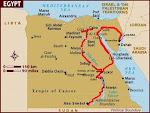
Entering Egypt


We entered Egypt via the fast ferry which crosses from Aquaba to Nuweiba once daily. After boarding the ferry we were corralled, along with the other foreigners into an area in the front of the boat where we were politely made to stay. Gaby though was able to "persuade" the ships captain to give us a personal tour of the boat, and she took some great pictures from the top of the boat of the surrounding area. The captain was a very nice guy and had worked down in Argentina earlier in his career. We met some great people while on the boat, including a retired German couple who were driving from Germany to South Africa.

We arrived at the port of Nuweiba and walked toward immigration. The area was chaotic as traders carted their merchandise around and locals struggled with big bags. We got our passports taken care of and walked out into Nuweiba Town.

Egypt was a change from what we had seen until then. It was definitely the poorest country we had seen so far in the trip and it was the first time that we really saw misery and abject poverty. In addition we had to deal with being hassled, cheated and lied to by the locals. We had been hassled a bit before Egypt but once in Egypt it was exponentially worse. We would have to deal with it during our entire stay in the country.

Nuweiba was a small port town located on the beautiful Red Sea. Backed by stark sandy colored mountains it was dry we saw lots of camels on our drive to our camp.

Finally our taxi arrived at our camp. We had arrived at a little slice of paradise.

Steve

Our Impressions Of Jordan


We had just come from Syria with the warmth of its people and knew from the very beginning that Jordan was going to be different. From the moment we crossed the border the developed world infrastructure was there. There was a lot more wealth in this country, which has a forward looking leader, educated in Great Britain and married to a British woman. This clearly caused Jordan to be one of the wealthiest and more progressive countries in the region in spite of the fact that it is squeezed between the hot-spots of Iraq, Saudi Arabia and Israel and the Palestinian Territories and surrounded by political and religious extremism.

Jordan has an extraordinary high proportion of refugees who have brought their money and possessions and helped build a major part of the country.

The whole country is a dry desert. A mountainous desert to the west where they have managed to irrigate and grow some crops that are important to the economy and the flat desert to the east with a few wetlands that are quickly drying up due to overuse by locals for agricultural purposes.

We did find Jordan to be a bit complicated for independent travelers with a economy budget due to the lack of public transportation and we really got to see more of it after deciding to share a rental car with a German couple that had similar interests to ours.

The Biblical sites (over 100 are mentioned in the Bible) pull you in and even the none-religious will feel an enchantment with the age old landscapes and experience an intense journey. It is quite amazing to wander through the land where so much happened so many years ago, so much that defined the world today and caused some of the religious extremism that the world is now a victim of. Visiting the place where Jesus was baptized had definitely an impact on us.

It was interesting to be able to see with our own eyes some of the controversial places we read about in the news very often, such as the Golan Heights and the West Bank but we certainly didn't enjoy the sound of firearms and canons disrupting the silence of the desert.

Swimming in the Dead Sea (the lowest place on earth) was an outrageous experience that still holds a position among the top "most bizarre things" we've experienced. I couldn't help but think of a couple of summers ago when we took my parents to the lowest place on the continental US, Death Valley, and we nearly killed them after the A/C in our car broke! Although at the Dead Sea it was not the middle of the summer nor was it 50ºC and here we had water!

Being able to attend a wedding for me was quite a magical moment that couldn't be more of a genuine sight of the culture and I very much enjoyed it.

As an Argentinean people kept referencing soccer players from my country and also the fact that the King and Queen of Jordan (of whom you can see their picture everywhere, from shops to cars) had recently paid a visit to South America and had met with the Argentinean President, who they thought was "quite beautiful" (I decided to keep my mouth shut and not comment on this subject).

And then ... visiting Petra, one of the "New seven wonders of the world". The UNESCO World Heritage site that battles it out with Machu Pichu in Peru and Angkor Wat in Cambodia for the World's most dramatic "Lost City". It was simply an amazing, high wow factor, jaw dropping experience that it was by itself worth a visit to the Hashemite Kingdom of Jordan.

Gaby

Jordan Food


I had been looking forward to taking a cooking course in Jordan. I was finally going to have great recipes of traditional dishes to take home and cook for years to come!

"Petra Kitchen" is a professional cooking school set up with everything that is needed to teach, learn, cook and then enjoy the efforts made earlier.

I had personally signed up a few hours after showing up in Wadi Musa and had met the head Chef. A few days later I walked into the place to find out that there were 47 of us (a group of 23 couples traveling in a package tour through the Holy Land and me). It definitely worked to my advantage the fact that the group was there just for fun and the chef took me under his wing and explained step by step each dish.

Jordanian food is made up of Lebanese, Syrian and Egyptian influences, blended with traditional Bedouin. Just like in Syria, one of the most popular things are the Mezze. The word derives from the Arabic "T'Mazza" meaning "to savor in little bites". We also found the usual Hummus, Baba Ghanooj, Tabbouleh and Fattoosh of which I talked about in the blog entry about Syrian food. There is also plenty of Shwarma and Felafels as well as Khobz (Arabic bread) and roasted chicken.

We really did get to enjoy the Bedouin "Mensaf" (Lamb on a bed of rice and pine nuts. The fat from the cooking is poured into the rice. A tangy sauce of cooked yogurt mixed with the fat is served with it..

Jordanians definitely have a sweet tooth and their desserts definitely show it. There are tons of dessert shops where they sit and take care of their cravings! Desserts usually involve some sort of dough (usually filo pastry), tons of honey, syrup or rose water, and many times all of these three combined! "Muhalabiyya" was one of our favorites! (Rice pudding made with rose water).

Although a Muslim country, there are several shops around that are licensed to sell liquor. One of the favorite drinks for locals seem to be Arak (Aniseed drink similar to Turkish Raki or Greek Ouzo). The majority of the people seem to stick to the usual "Shai" (Tea) which they consume extra strong and extra sweet. Steve quickly had to learn to say "Sukkar Galeel" (little sugar) and "Bidoon Sukkar" (no sugar) for me. We very much enjoyed the "Shai ma m'arana" (mint tea), "The Zaatar" (Thyme) and "Marrameeya" (Sage).

You can definitely not go hungry in Jordan!!!

Gaby

Aqaba - Red Sea


The next morning we hired a car and along with our German friends we drove out of the mountains from Petra down through the desert to the town of Aquaba. Located on the northern tip of the Red Sea, Aqaba is Jordan's only resort town and is known for its diving and snorkeling. Its location is odd as there are four countries that share the northern coast of the Red Sea there and you have the cities of Eliat (Israel), Taba (Egypt), and Haqi (Saudi Arabia) just a stones throw away.

We found the fantastic Al-Amer Hotel which had terrific sea view rooms, hot showers and a balcony where we could sit out and enjoy the cool evenings. For the next couple of days I got over my lingering food poisoning/sickness and we relaxed, strolled around the markets and prepared for our upcoming cross into Egypt. The city was quiet, laid back, had beautiful weather and as it was a tax-free zone was inexpensive. It was just what we needed to recoup and recharge.

After resting a couple of days we went snorkeling with a local dive company to a couple of spots down by the Saudi border. The water was clear and the condition of the coral was outstanding, some of the best I have ever seen. But we were impressed by the fact that there were fewer fish there than we had seen in other locations. Maybe they were fishing there a lot. In the evenings we would climb on the roof with our German friends and enjoy a beer while looking out over the city.

But all good things must come to an end and Egypt was beckening us. So we bought ferry tickets and the next day we took the morning ferry to Egypt.

Steve

Petra


Petra was one of the reasons we chose to do this trip through the Middle East and we really looked forward to seeing it. Ever since I watched Indiana Jones as a kid the place had intrigued me. Now we would get to see it in person. When we showed up at Wadi Musa (the town that supports Petra) I was trying to get over my bad case of food poisoning and I was still hurting. Our hotel was OK but because of the elevation it was freezing cold in our room which didn't help me much.

Petra was built by the Nabateans (Arabs who dominated the region in pre-Roman times) who choose as their capital a place concealed from the outside world and made it into one of the Middle Easts most remarkable cities. At its peak (8BC to 40AD) the city had about 30,000 residents and a zone of influence from Syria to Egypt. Then the city declined and the local Bedouins who continued to live in the buildings hid its location from outsiders, fearful that they would interfere with their livelihood. Then in 1812 a young Swiss explorer named JL Buckhardt found Petra by learning Arabic, dressing as a Arab and tricking the locals into showing it to him. Even to this day only 5% of the park has been excavated.

From the entrance of Petra you walk down the Siq, a 1.2km passageway cut between the rocks. The layers of multicolored sandstone rise straight above your head. The tension rises as you round every corner, waiting to be finally rewarded with a glimpse of the famous Treasury between the rocks. Suddenly it is there before you. The condition of the treasury after so much time and its location in this picturesque narrow sandstone canyon was amazing. We had gotten up early to beat the throngs of packaged tourists and at 7am were able to enjoy the site in relative solitude. The amazing thing about Petra is that after you see the Treasury you still have the rest of the park to check out. You see many Nabataean tombs that are cut out of the multicolored rock face. There is a Nabataean theatre and a Roman colonaded street, a Byzantine church with well preserved mosaics and caves with frescos on the walls and hundreds of other ruins.

Any one of these things would have made Petra worthy of visiting on their own but the combination of all of them plus the amazing desert mountain scenery (think Canyonlands or Zion National Parks) makes Petra truley special. We spent the entire day exploring the park and that evening returned to see "Petra by Night." For this they lined the walkway through the Siq to the Treasury with hundreds of candles. You walk though the Siq by candlelight until you get to the Treasury, where they play Bedouin music and storytellers tell stories. It was a surreal experience. We had bought a multi-day pass and spent the second day seeing what we had missed and hiked up to one of the high places of sacrifice. From up there you could see views over the valley of Petra and the surrounding area.

Petra was for us a really amazing experience and a definate highlight of the trip. We would highly recommend to everyone to take the opportunity to see Petra at some point. It is well worth it.

After 3 days of walking in the area and our freezing cold hotel room I was still feeling terrible from my food poisoning. I told Gaby that I needed a couple of days off to rest up and recuperate. Our German friends suggested we get away from the cold and tourist trap prices of Wadi Musa and head to the resort city of Aqaba. Little did we know how good a suggestion it was.

Steve

Desert Castles


"The deeper you go into the desert, the closer you come to God" Arab Proverb

Jordan's eastern desert is a flat, dry and featureless expanse. It was not sandy but instead had "badia", a stony black basalt desert without any vegetation. We stayed the night in the Oasis town of Azraq with our German friends Thorston and Tanya. Located 30 miles from the Saudi border and 100 miles from Iraq the town is little more than a truck stop for trade and pilgrimage routes between those countries and Jordan and we had little interest in staying there very long. Our reason for seeing the eastern desert is because we visited a string of buildings (pavilions, caravansaries, hunting lodges and forts) known collectively as "desert castles". Most were built by the Damascus based Umayyads (AD 661-750) as their agricultural or trading complexes and country retreats.

Al-Azraq was a castle made up of blocks of black basalt. The ruins are somewhat intact but little remains of decoration or purpose of the building. Still it was interesting to climb through the ruins and see it.

Qasr Al-Kharrana is a desert castle which was located in the middle of nowhere. It was cool to climb on the roof of it and stare out over the expanse of desert in all directions.

The highlight of the day was Qasr Amra, an ancient royal bathhouse that has wonderful frescos of hunting, dancing and musician scenes. UNESCO has designated Qasr Amra as a World Heritage Site and it feels like it as the small building barely contained the throngs of tourists that were bussed in and out of the site. It was nice but not for seekers of solitude.

That evening we returned to Madaba, our base for the north of the country. We stopped into a restaurant to grab a sandwich before heading to the hotel. I saw a delicious looking filling called the "fajita chicken" and ordered a sandwich of that, as opposed to the falafel that everyone else ordered. That night the nausea hit and I spent most of the night retching my guts out. After getting everything out of my system I slept the whole next day. I felt like I had been run over by a truck. The following day I dragged myself to the bus station and we headed to Petra.

Steve